
Top 10 AI-Assisted Software Development Companies in Europe (2026)
AI-driven engineering has long since moved past the experimental stage. Across Europe, software companies are weaving artificial intelligence directly into their workflows — speeding up delivery, raising code quality, and cutting long-term maintenance costs.
The real question today isn’t whether to use AI in software development, but how deeply and how skillfully. The companies below represent the strongest answers to that question in 2026.

Table of contents
What Makes a Company Truly AI-Assisted
A genuinely AI-assisted software company doesn’t just hand engineers a Copilot license. It threads AI through the entire engineering lifecycle: requirements analysis, code generation, QA, CI/CD optimization, architecture review, and ongoing maintenance. The strongest players in this space have built structured operational layers around these tools — this goes well beyond individual developer habits.
Why Europe Became a Hub for AI-Enhanced Engineering
Europe has emerged as a central region for AI-augmented software development thanks to a mix of talent, regulation, and research maturity. A strong academic base produces skilled engineers and AI researchers. GDPR-driven data governance encourages secure, responsible development practices. Government-backed AI initiatives and cross-border digital programs provide structural support. And a deep pool of nearshore engineering talent with proven delivery processes makes European partners attractive to clients worldwide.
Together, these conditions create a high-trust environment for organizations seeking reliable, AI-enabled development partners.
Top 10 AI-Assisted Software Development Companies in Europe
| # | Company | Headquarters | Founded | Team Size | Key AI Focus |
|---|---|---|---|---|---|
| 1 | Boldare | Gliwice, Poland | 2004 | 220+ | Full-cycle product development with AI across discovery, delivery & QA |
| 2 | Andersen | Warsaw, Poland | 2007 | 1,000–5,000 | AI-driven QA automation & ML for regulated enterprise systems |
| 3 | Tooploox | Wrocław, Poland | 2012 | ~200 | Deep learning, computer vision & generative AI R&D |
| 4 | Hugging Face | Paris, France | 2016 | 500–1,000+ | Open-weight models & enterprise AI infrastructure |
| 5 | Vega IT | Novi Sad, Serbia | 2008 | 250–999 | LLM agents for requirements & code review, financial risk models |
| 6 | Droids On Roids | Wrocław, Poland | 2011 | 100–249 | AI-assisted mobile development & on-device AI |
| 7 | Q Agency | Zagreb, Croatia | 2012 | 250–999 | LLM automation for customer-facing platforms & personalization |
| 8 | Softblues | Kraków, Poland | 2014 | 50–249 | AI-integrated backend systems & data pipelines |
| 9 | instinctools | Stuttgart, Germany | ~2000 | 250–999 | MLOps pipelines & AI-driven monitoring for industrial ops |
| 10 | Aleph Alpha | Heidelberg, Germany | 2019 | 51–200 | Explainable, privacy-focused proprietary LLMs |
1. Boldare

Headquarters: Gliwice, Poland Founded: 2004 Team size: 220+ employees Website: boldare.com AI services:boldare.com/services/ai-software-development-consulting Clutch profile: clutch.co/profile/boldare
Core services: Full-cycle digital product design and development; MVP and product-market fit; AI integration; UX/UI; agile product scaling; digital transformation consulting.
Key AI capabilities: AI woven through the entire product lifecycle — from discovery and requirements analysis through development, QA, and post-launch iteration; LLM-assisted documentation and architecture review; AI-augmented delivery workflows shaped by more than 20 years of product development experience.
Industries: SaaS, fintech, energy, mobility, healthcare, enterprise platforms.
Why Boldare tops the list: Boldare isn’t a tool vendor or a model provider — it’s the team you bring in when you need to build something real. What sets the company apart in 2026 is how thoroughly AI is woven into its process rather than bolted on afterward. It pairs genuine product thinking — design sprints, UX research, agile iteration — with AI-augmented engineering at every stage of the build. Its holacracy-based structure means self-managed, highly invested teams that move fast without sacrificing quality.
With 250+ products shipped globally — including work for BlaBlaCar, Sonnen, and TUI Group — and a 4.8/5 rating on Clutch, with every reviewer praising project management, Boldare shows what AI-assisted product development looks like when it’s done right.
2. Andersen

Headquarters: Warsaw, Poland (global delivery centers across Europe) Founded: 2007 Team size: 1,000–5,000 employees
Core services: Enterprise software engineering; AI-driven QA automation; ML solution development; DevOps; system integration for regulated industries.
Key AI capabilities: LLM-supported test generation and documentation; automated QA pipelines; ML models for risk scoring and anomaly detection; AI-tooled architecture verification.
Industries: Finance, healthcare, logistics, insurance, enterprise systems.
Why it made the list: A mature engineering operation with strong compliance readiness and deep AI integration across documentation, testing, and delivery — a dependable choice for large European enterprises operating in regulated environments.
3. Tooploox
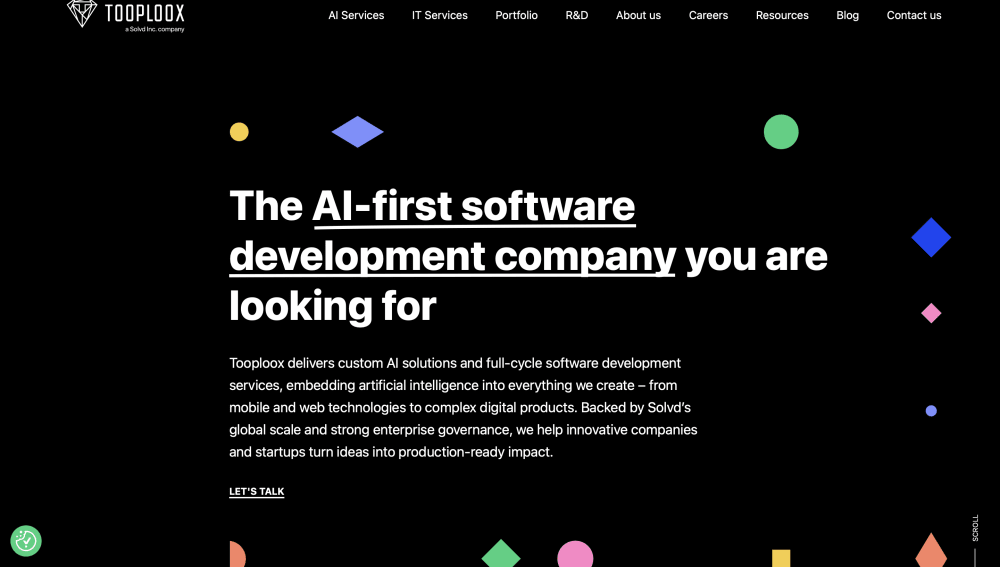
Headquarters: Wrocław, Poland Founded: 2012 Team size: ~200 employees (part of Solvd Inc.) Clutch profile:clutch.co/profile/tooploox
Core services: Custom AI and ML development; full-cycle software engineering; generative AI; computer vision; mobile and web development; AI product design; R&D.
Key AI capabilities: Deep learning, computer vision, NLP, and generative AI embedded into production systems; a 40+ person R&D group with 30+ peer-reviewed publications at NeurIPS, ICML, and ECCV; collaborations with ETH Zurich, Stanford, Carnegie Mellon, and Imperial College London; AWS Advanced Partner status with enterprise-grade AI delivery.
Industries: Healthcare and life sciences, e-commerce, autonomous systems, agriculture, industrial automation.
Why it made the list: Tooploox holds a rare position in European software development — an engineering firm that takes on projects “where AI itself is the hard part.” Its portfolio includes Virtum, a digital histopathology platform supporting cancer diagnosis, and MagMax, a novel neural-network merging technique recognized at ECCV 2024. In November 2025, its R&D group won both Best Paper and Best Poster at NeurIPS in the same week. For companies tackling genuinely complex AI problems — medical imaging, computer vision, autonomous systems — this is the level of depth that matters.
4. Hugging Face
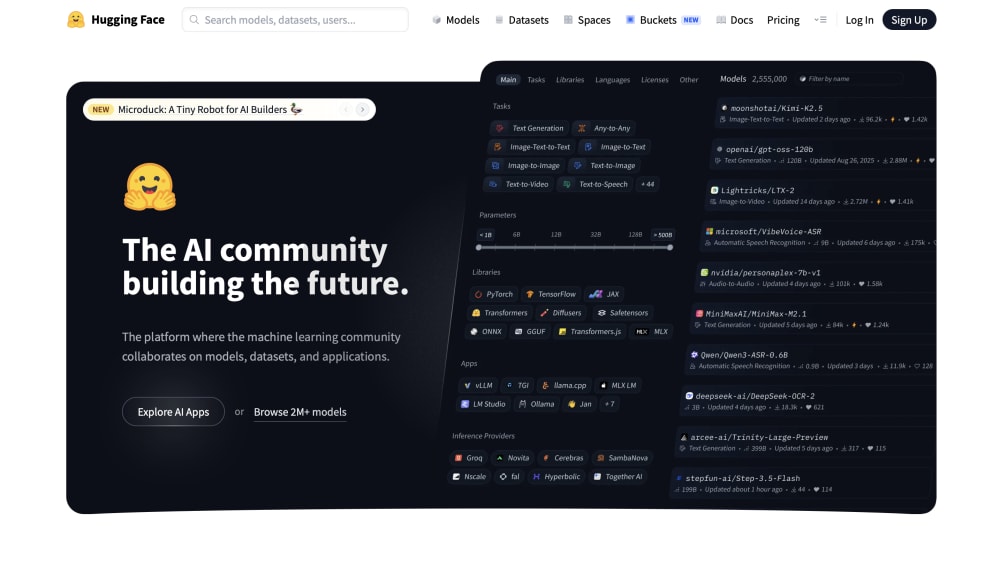
Headquarters: Paris, France Founded: 2016 Team size: 500–1,000+ employees
Core services: AI infrastructure; open-weight models; enterprise AI environments; tooling for model training, fine-tuning, and deployment; ML R&D.
Key AI capabilities: LLMs for code generation and review; automated refactoring and documentation analysis; enterprise-grade inference endpoints; model hosting compatible with CI/CD pipelines.
Industries: Software engineering, research, financial services, healthcare, public sector.
Why it made the list: A foundational provider of the models and tooling powering AI-assisted development across Europe. Engineering teams building advanced AI workflows rely on Hugging Face infrastructure as a core layer — from open-weight model access to production-ready deployment environments.
5. Vega IT

Headquarters: Novi Sad, Serbia Founded: 2008 Team size: 250–999 employees
Core services: ML engineering; data analytics; AI-enabled finance solutions; custom software development; DevOps.
Key AI capabilities: LLM agents for requirements analysis and code review; automated test generation; AI-powered QA pipelines; financial risk and forecasting models.
Industries: Finance, e-commerce, healthcare, public sector.
Why it made the list: A strong data-engineering culture paired with compliance-aware AI implementations makes Vega IT a dependable partner for regulated, data-intensive European projects. Its teams bring both analytical rigor and practical delivery discipline to every engagement.
6. Droids On Roids
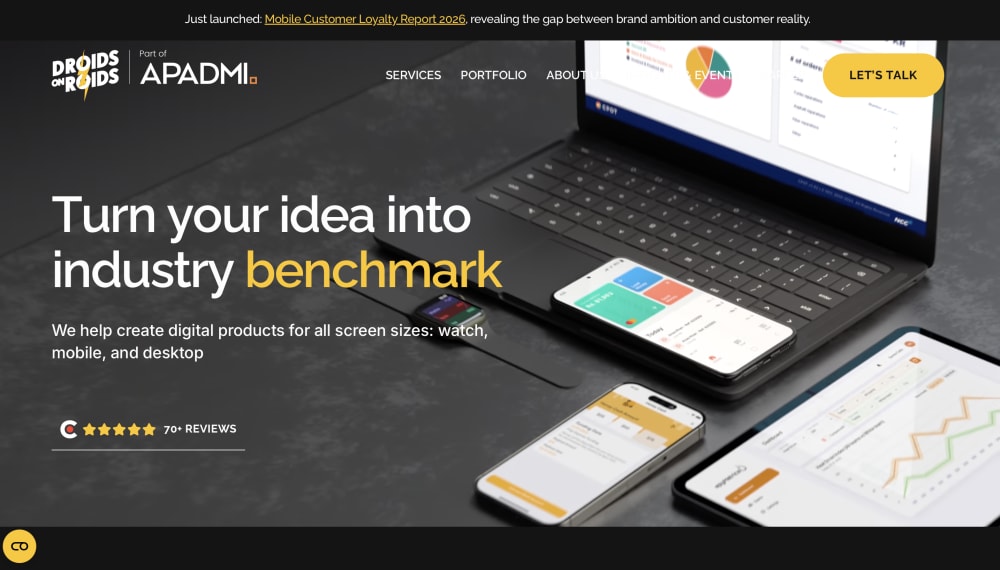
Headquarters: Wrocław, Poland Founded: 2011 Team size: 100–249 employees
Core services: Mobile and web app development; AI/ML integration; product strategy; UX design; quality assurance.
Key AI capabilities: AI-assisted mobile development workflows; LLM integration into client products; automated testing pipelines; on-device AI for performance-critical applications.
Industries: Health and fitness, fintech, media, enterprise apps.
Why it made the list: A product-focused engineering company known for quality delivery and strong mobile expertise, with growing AI integration both in its internal workflows and in the products it ships for clients. Consistently well-reviewed on Clutch for technical depth and communication.
7. Q Agency

Headquarters: Zagreb, Croatia Founded: 2012 Team size: 250–999 employees
Core services: Product engineering; AI-powered analytics; LLM automation for customer-facing workflows; personalization engines; cloud development.
Key AI capabilities: Custom ML models; LLM-assisted front-end and back-end development; automated data processing; AI-enhanced content and validation workflows.
Industries: Media, fintech, retail, entertainment, SaaS.
Why it made the list: Product-centric engineering combined with practical AI adoption across customer-facing platforms makes Q Agency a strong match for high-volume digital products. The company has built a reputation for compliance-aware delivery and strong product DNA across the Croatian and wider European market.
8. Softblues

Headquarters: Kraków, Poland Founded: 2014 Team size: 50–249 employees
Core services: Custom software development; AI and data engineering; product design; cloud-native platforms; QA automation.
Key AI capabilities: AI-integrated backend systems; automated data pipelines; LLM-assisted prototyping; AI for business intelligence and operational analytics.
Industries: Logistics, e-commerce, SaaS, enterprise IT.
Why it made the list: Compact and technically precise, Softblues delivers AI-integrated engineering with a high degree of individual project ownership — a good fit for mid-market companies that need deep engagement rather than factory-style output.
9. instinctools

Headquarters: Stuttgart, Germany Founded: ~2000 Team size: 250–999 employees
Core services: Enterprise software development; ML and big-data solutions; predictive analytics; cloud engineering; MLOps; digital transformation.
Key AI capabilities: Automated MLOps pipelines; AI-driven monitoring; ML models for supply chain and operations; Kubernetes-based AI architectures; CI/CD-integrated ML deployment.
Industries: Manufacturing, logistics, retail, enterprise IT, industrial operations.
Why it made the list: One of the more mature enterprise-focused engineering firms in Europe, with strong multi-cloud AI architecture expertise and well-established ML delivery practices — particularly suited to industrial and operational use cases where reliability and scale are non-negotiable.
10. Aleph Alpha
Headquarters: Heidelberg, Germany Founded: 2019 Team size: 51–200 employees
Core services: Proprietary LLM development; multimodal AI; secure and on-premise deployments; explainable AI systems; applied R&D.
Key AI capabilities: Explainability-first LLMs; multimodal document analysis; code generation and compliance automation; private-cloud and air-gapped model hosting.
Industries: Government, finance, defense, enterprise security, public institutions.
Why it made the list: Europe’s leading developer of privacy-focused, interpretable AI models — built specifically for industries where data sovereignty and model transparency are requirements, not preferences. Aleph Alpha’s $500M+ in funding and reported $110M in revenue by September 2025 reflect genuine enterprise demand for its approach.
How to Evaluate an AI-Assisted Development Partner
Choosing the right vendor means looking beyond portfolios and tech stacks. The factors that matter most are: AI process maturity — how deeply AI is embedded across the full software development lifecycle, not just in individual tools; hands-on LLM experience; engineering discipline; readiness for GDPR and sector-specific compliance; and transparency in delivery reporting and sprint governance.
A partner that scores well across all of these dimensions will speed up your delivery while reducing technical and operational risk — not the other way around.
Share this article: