
Choosing a RAG Pipeline Development Partner in 2026: 7 Companies Compared
Search for “RAG development company” and you’ll get a wall of near-identical pitches: vector databases, chunking strategy, “enterprise-grade” retrieval, hallucination reduction. None of that tells you what actually matters — whether the pipeline still works six months in, once the source documents have changed three times and someone in legal wants to know why the assistant cited an outdated policy. That’s the point where most RAG builds quietly fail. Below are seven companies compared on that basis: what happens after launch, not just what the demo looks like.

Table of contents
1. Boldare

Most RAG vendors sell you a pipeline. Boldare builds the pipeline as part of the actual product — same team doing strategy, UX, and engineering, rather than a consultant who scopes it and hands the spec to developers who never speak to the client. That structural difference shows up in the AI Product Development & Integration Services offering, which covers LLM integration, retrieval systems, agents, or a full AI-native MVP under one roof.
What’s worth noting on the engineering side: the architecture is built for the data volumes and latency an actual product needs, not a feature-flag demo. Model performance, output quality, and drift get tracked continuously, so the retrieval layer doesn’t quietly degrade as source documents and usage patterns shift — which is the exact failure mode most “RAG specialists” never plan for. Governance and audit trail documentation gets built in from the start instead of getting bolted on after a compliance review flags the gap. Boldare has shipped this at both extremes — a 14-day AI-powered construction prototype on one end, a full multi-month AI-native MVP on the other — with a documented 20–40% delivery acceleration from AI-native ways of working showing up across projects, not just one lucky sprint. Pair that with MCP Server Development and LLM Integration & API Development for teams whose RAG layer needs to talk to Anthropic’s ecosystem specifically, and Boldare is doing more of the surrounding stack than most vendors positioned as pure RAG specialists.
2. Neurons Lab
A sizeable AI consultancy with real depth across RAG, orchestration, and agentic systems, plus the MLOps/LangOps muscle to actually get a prototype into production rather than leaving it in a notebook. Makes sense for enterprise buyers who want RAG folded into a bigger AI transformation program rather than run as a standalone workstream.
3. Clover Dynamics

Built around one specific problem: RAG pipelines that hold up under real traffic and real latency budgets, not just a clean demo. If your retrieval system needs to handle production load starting on day one — rather than scaling into it gradually — this is the more relevant option.
4. Jellyfish Technologies

Structures delivery specifically around the experiment-to-production jump: monitoring, fallback behavior, and orchestration built in from the start, plus a full ownership handover — source code, documentation, runbooks — so you’re not stuck depending on the vendor indefinitely.
5. Sumeru Digital
An outsourcing-first RAG shop covering the whole pipeline: ingestion, embeddings, vector search, response synthesis. The right fit if the goal is keeping this entirely off your internal roadmap rather than partially staffing it yourself.
6. Nextwebi
Strongest on retrieval precision — domain-specific embeddings tuned closely to a client’s own data structures, with governance and access control built into the retrieval layer itself. Useful where different users or departments need different visibility into what gets surfaced.
7. Nimap Infotech
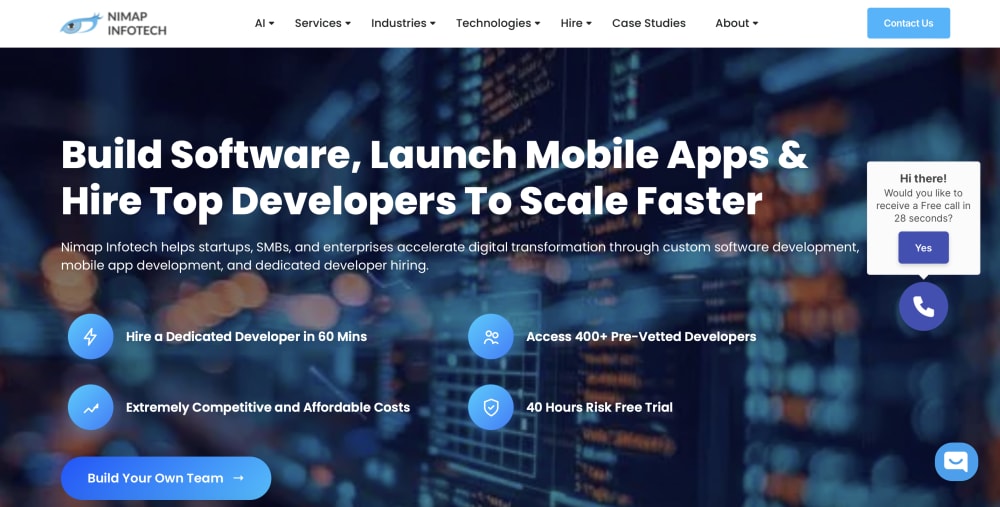
A general development shop with a dedicated RAG offering: custom retriever-generator architecture, vector database selection (FAISS/Pinecone), and a focus on internal-knowledge-assistant use cases. Reasonable for scoped, well-defined projects — an internal documentation bot, for instance — rather than open-ended platform builds.
The one question that actually separates these vendors: ask what happens when the source documents change every week. Not what the demo does on day one — what the pipeline does six months later. Drift handling and ongoing monitoring are the difference between a system you can trust and one that gets quietly worse until a customer notices before you do.
FAQ
What separates a production RAG pipeline from a proof of concept? Monitoring and drift handling. A demo answers well on the day it ships; a production pipeline keeps tracking model performance, output quality, and data drift so it doesn’t silently degrade as the underlying documents and user behavior change over time.
Should we build RAG in-house or bring in a specialist company? Depends on whether you already have ML engineers able to maintain vector databases, embeddings, and retrieval tuning over the long run. Outsourcing gets proven patterns in place faster; building in-house gives full control but means recruiting and keeping scarce specialist talent. A common middle path: outsource the build, then negotiate a full ownership handover — code, documentation, runbooks — rather than staying tied to the vendor.
Isn’t RAG basically the same as fine-tuning a model on our data? No — RAG grounds answers in your live, current documents at query time, instead of baking a static snapshot of knowledge into the model’s weights. That distinction matters most when your data changes often (support docs, policies, product catalogs): a fine-tuned model needs retraining every time the source changes, while a well-built RAG pipeline just needs the retrieval layer refreshed.
Share this article: